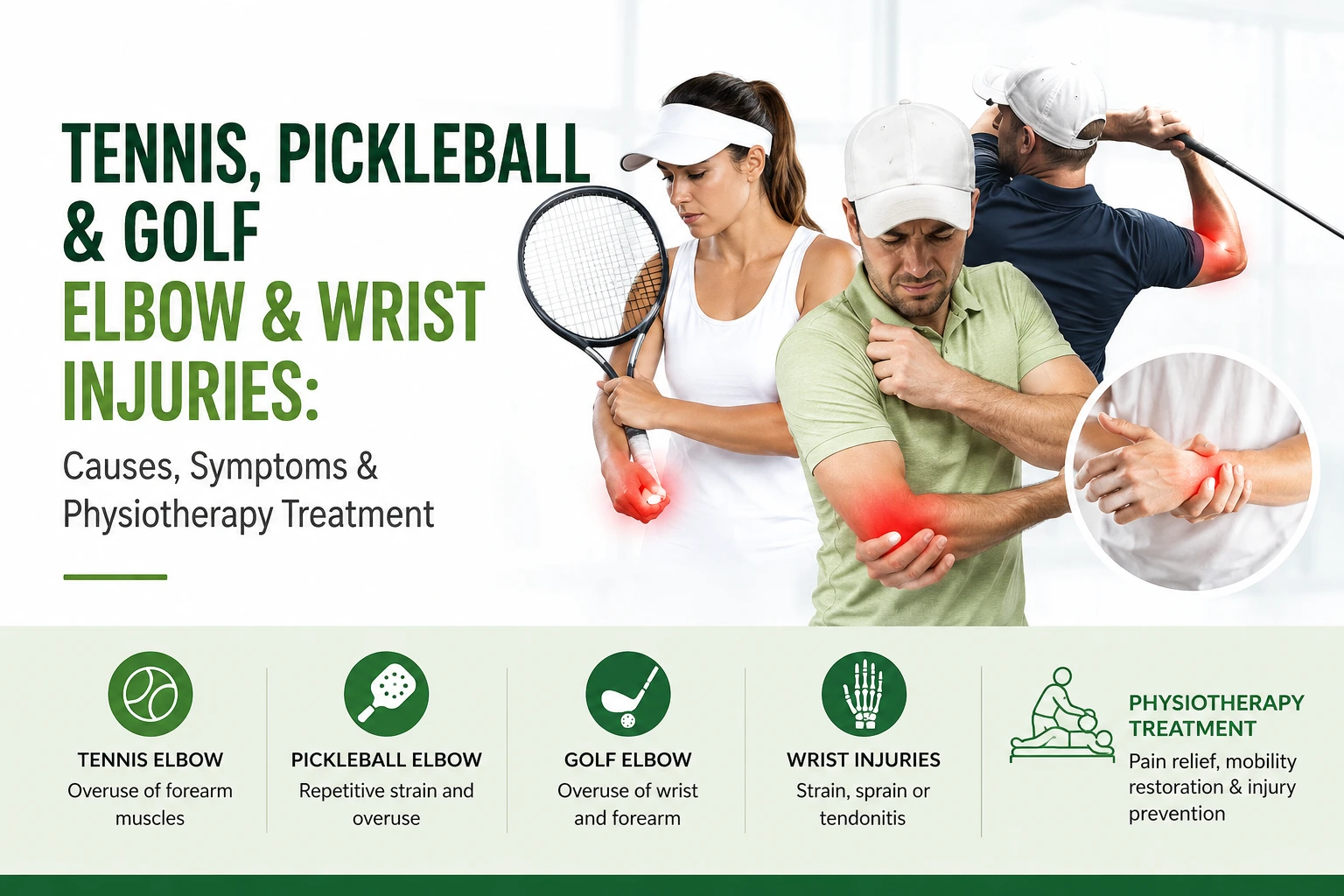
Tennis, pickleball, and golf are excellent sports for fitness, coordination, and recreation—but repetitive gripping, swinging, serving, and impact can place significant stress on the elbow, wrist, thumb, and forearm.
At Townline Physiotherapy Abbotsford, I frequently see recreational and competitive players with elbow and wrist pain that develops gradually or suddenly after increasing their playing time. Conditions such as tennis elbow, golfer’s elbow, tendinitis, wrist pain, and thumb injuries can affect your ability to grip a racquet, swing a club, or enjoy your favourite sport.
The good news is that appropriate physiotherapy can help reduce pain, restore strength and mobility, and safely get you back to playing.
— Jimmy, Physiotherapist at Townline Physiotherapy Abbotsford
Why Do Tennis, Pickleball & Golf Cause Elbow and Wrist Injuries?
All three sports involve repetitive movements, but each places different demands on the upper limb.
Tennis
Repetitive forehand and backhand strokes
Serving
Strong gripping
Repetitive wrist movements
Pickleball
Rapid repetitive swings
Quick reaction shots
Repetitive gripping
Frequent wrist movements
Sudden changes in direction
Golf
Repetitive swinging
Strong gripping
Impact with the ball
Wrist rotation
Repeated practice swings
A sudden increase in playing frequency, poor technique, inadequate recovery, or inappropriate equipment can increase the risk of injury.
Tennis Elbow
Tennis elbow, medically known as lateral elbow tendinopathy, affects the tendons on the outside of the elbow.
Despite its name, you don’t have to play tennis to develop it. Pickleball players, golfers, tradespeople, office workers, and anyone who performs repetitive gripping can develop tennis elbow.
Tennis Elbow Symptoms
You may experience:
Pain on the outside of the elbow
Forearm pain
Pain while gripping a racquet
Pain lifting a coffee cup or pan
Weak grip
Pain opening jars
Discomfort during a backhand stroke
Tenderness around the outside of the elbow
Pain may initially occur only during activity but can become persistent if the tendon continues to be overloaded.
Golfer’s Elbow
Golfer’s elbow, or medial elbow tendinopathy, affects the tendons on the inside of the elbow.
It can occur in golfers but is also common in people who perform repetitive gripping, lifting, or wrist movements.
Golfer’s Elbow Symptoms
Common symptoms include:
Pain on the inside of the elbow
Forearm discomfort
Pain when gripping
Pain during golf swings
Pain lifting objects
Wrist weakness
Tenderness around the inner elbow
Elbow Tendinitis & Tendinopathy
Repeated loading can irritate the tendons around the elbow.
You may notice:
Pain during activity
Morning stiffness
Tenderness
Reduced grip strength
Pain after playing
Symptoms that worsen as activity continues
It’s important to distinguish between an acute tendon injury and chronic tendinopathy because treatment and loading strategies may differ.
Wrist Pain in Tennis, Pickleball & Golf
Wrist pain can develop from repetitive swinging, gripping, falls, or direct impact.
Persistent wrist pain should be assessed rather than repeatedly playing through it.
What About “Goalkeeper’s Thumb”?
A goalkeeper’s thumb is usually a thumb ligament injury—most commonly involving the ulnar collateral ligament (UCL) at the thumb’s MCP joint. It is classically associated with a forceful sideways movement of the thumb, such as during sports or a fall.
Although it is called “goalkeeper’s thumb,” similar injuries can occur during many activities.
Symptoms May Include
Pain at the base of the thumb
Swelling
Bruising
Pain gripping objects
Weak pinch strength
Difficulty holding a racquet or golf club
Thumb instability
A significant thumb injury should be properly assessed because some UCL injuries require medical or surgical management rather than physiotherapy alone.
Physio Jimmy’s Assessment
At Townline Physiotherapy Abbotsford, I don’t simply treat the location of your pain. I look at why the injury happened.
Your Assessment May Include
Elbow range of motion
Wrist mobility
Thumb stability
Grip strength
Forearm strength
Shoulder function
Racquet or club grip
Sport-specific movements
Training volume
Technique and movement patterns
This assessment helps determine whether your symptoms are related to a tendon, muscle, joint, ligament, nerve, or another structure.
Physiotherapy Treatment
Dry Needling
Dry needling may be used to address tight forearm muscles and myofascial trigger points contributing to pain and restricted movement.
Potential benefits include:
Reduced muscle tension
Improved mobility
Pain relief
Improved muscle function
It is generally combined with active rehabilitation rather than used alone.
Cold Laser Therapy
Cold laser therapy, also known as low-level laser therapy, may be incorporated into the treatment of selected soft-tissue and tendon conditions.
Potential benefits include:
Pain reduction
Reduced inflammation
Support for tissue healing
Improved local circulation
Your physiotherapist will determine whether laser therapy is appropriate for your injury.
Therapeutic Taping
Taping may provide additional support during your recovery.
It can be used to:
Support an injured area
Reduce excessive loading
Improve movement awareness
Provide temporary support during activity
Help with a gradual return to sport
Taping should complement strengthening and rehabilitation rather than replace them.
Strengthening Exercises
For many elbow and wrist injuries, progressive strengthening is one of the most important parts of recovery.
Your program may include:
Wrist extension strengthening
Wrist flexion strengthening
Forearm rotation exercises
Grip strengthening
Eccentric exercises
Isometric exercises
Thumb strengthening
Shoulder and scapular strengthening
Sport-specific exercises
Exercises should be progressed gradually based on pain, strength, and function.
Return to Tennis, Pickleball & Golf
Returning to sport too quickly can cause symptoms to flare up.
A gradual return may involve:
Reducing playing volume temporarily.
Improving pain and mobility.
Building forearm and wrist strength.
Progressively increasing hitting or swinging.
Returning to full games once strength and tolerance improve.
Your physiotherapist can help determine when you are ready to increase your playing volume.
Tips to Prevent Elbow & Wrist Injuries
Warm up before playing.
Increase playing time gradually.
Avoid suddenly doubling your weekly activity.
Use equipment appropriate for your skill level.
Check racquet grip size and condition.
Avoid gripping the racquet or club excessively tightly.
Strengthen your forearms and wrists.
Allow adequate recovery between sessions.
Don’t ignore persistent elbow or wrist pain.
Why Choose Townline Physiotherapy Abbotsford?
At Townline Physiotherapy Abbotsford, we help recreational and competitive athletes recover from sports-related elbow, wrist, and hand injuries.
Our goal is not simply to reduce your pain—we want to help you restore strength, improve function, and confidently return to the sports you enjoy.
FAQ’s
1. Is tennis elbow common in pickleball players?
Yes. Pickleball involves repetitive gripping and wrist movements, which can place stress on the tendons on the outside of the elbow.
2. Can golfers get tennis elbow?
Yes. Golfers can develop either tennis elbow or golfer’s elbow depending on which structures are being overloaded.
3. How can I tell the difference between tennis elbow and golfer’s elbow?
Tennis elbow generally causes pain on the outside of the elbow, while golfer’s elbow generally causes pain on the inside. However, other conditions can produce similar symptoms, so an assessment is recommended.
4. Does dry needling help tennis elbow?
Dry needling may help reduce associated muscle tension and pain. For tendon injuries, it is generally combined with progressive strengthening and load management.
5. Can laser therapy help elbow tendinitis?
Laser therapy may help reduce pain and support tissue recovery in some soft-tissue and tendon conditions. It works best as part of a comprehensive rehabilitation program.
6. Should I stop playing tennis or pickleball if my elbow hurts?
Not necessarily. The appropriate amount of activity depends on the severity and cause of your injury. Sometimes modifying playing frequency, intensity, technique, or equipment is sufficient. A physiotherapy assessment can help determine an appropriate activity level.
7. How long does tennis elbow take to recover?
Recovery varies considerably. Tendon injuries can take weeks to months, particularly when symptoms have been present for a long time. A progressive rehabilitation program can help improve strength and load tolerance.
Book Your Sports Physiotherapy Assessment in Abbotsford
If you’re experiencing tennis elbow, golfer’s elbow, wrist pain, tendinitis, or thumb pain from tennis, pickleball, golf, or another sport, early assessment can help identify the cause and prevent the problem from becoming chronic.
At Townline Physiotherapy, Jimmy and the team provide personalized sports rehabilitation using dry needling, cold laser therapy, taping, manual therapy, and progressive strengthening exercises to help you get back to the game.