Shoulder pain can make surprisingly simple things difficult. Reaching into a cupboard, putting on a jacket, lifting something at work, sleeping on one side, or throwing a ball can suddenly become uncomfortable.
At Townline Physiotherapy & Wellness in Abbotsford, we often see people who have been trying to “work through” shoulder pain for weeks or months. Some remember a specific injury, while others notice that the pain gradually appeared without an obvious cause.
The important thing to understand is that shoulder pain is a symptom, not a diagnosis. There are many possible causes, and the right treatment depends on what is contributing to your pain and loss of movement.
Current clinical guidelines for rotator cuff-related shoulder pain emphasize a proper assessment and an active rehabilitation program rather than relying on one passive treatment alone.
Why Does My Shoulder Hurt?
The shoulder is designed to provide a large amount of movement. That mobility allows us to reach overhead, behind our back and across our body, but it also means the muscles, tendons and joints around the shoulder need to work together efficiently.
Pain may develop after an injury, repetitive activity or a sudden increase in workload. It can also appear gradually.
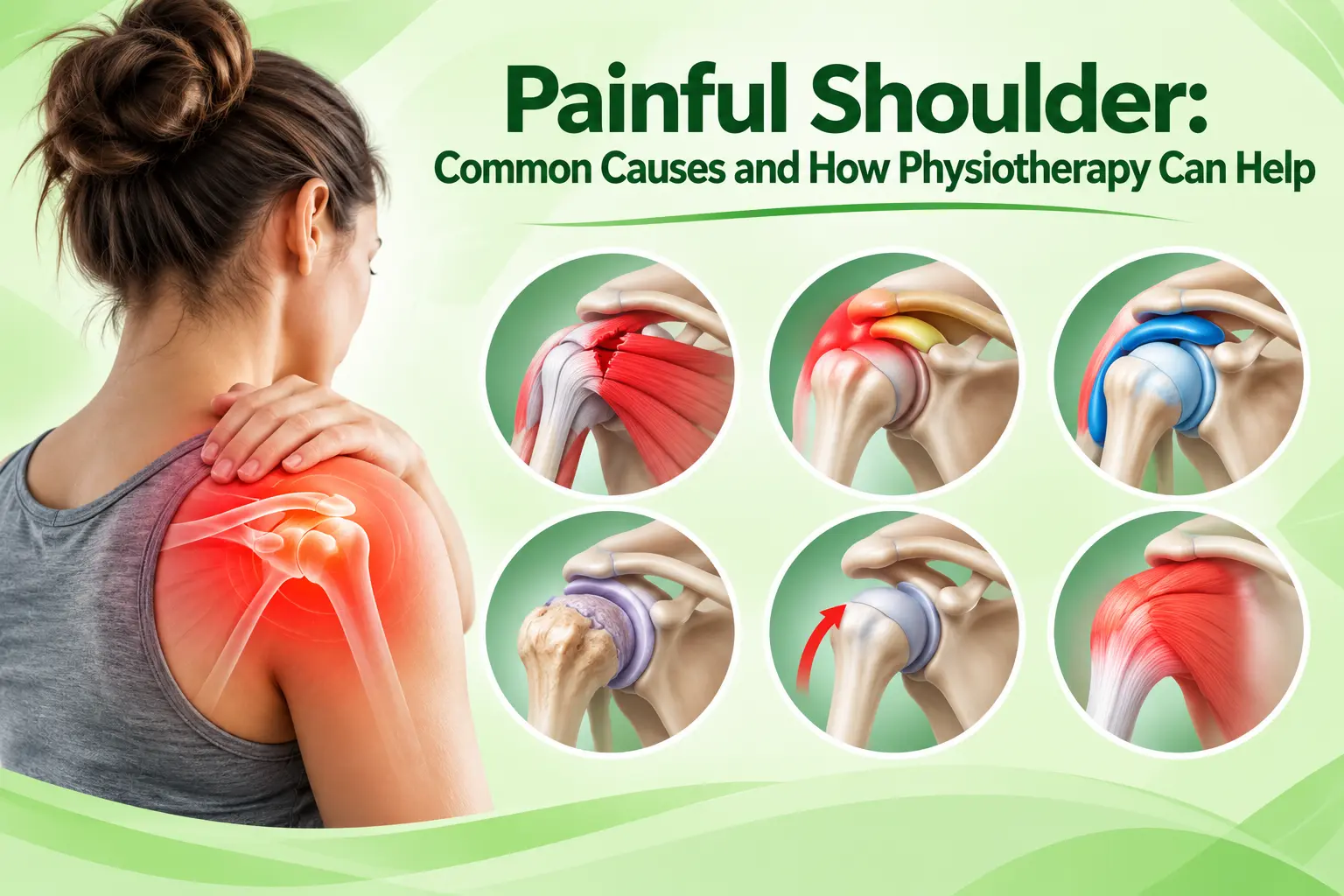
Rotator Cuff Tendinopathy
The rotator cuff is a group of four muscles and their tendons that help control and stabilize the shoulder.
Repeated lifting, overhead work, sports, changes in training volume or age-related tendon changes can contribute to rotator cuff pain.
Common symptoms include pain when raising the arm, discomfort reaching overhead or behind the back, weakness with lifting and pain when lying on the affected shoulder.
Rotator cuff disorders are among the most common shoulder conditions managed by physiotherapists.
Subacromial or Rotator Cuff-Related Shoulder Pain
Many people have heard the term “shoulder impingement.” It has traditionally been used to describe pain occurring when tissues around the rotator cuff and subacromial region become sensitive during arm elevation.
Today, physiotherapists generally look beyond the idea that something is simply being “pinched.” Shoulder symptoms can involve several factors, including tendon sensitivity, strength and load tolerance, shoulder and shoulder-blade movement, mobility and the demands being placed on the arm.
This is one reason a physical assessment is useful instead of trying to diagnose shoulder pain based on symptoms alone.
Rotator Cuff Tear
Rotator cuff tears can develop gradually or occur after trauma, such as a fall or forceful lifting injury.
A tear does not automatically mean surgery is required. Partial-thickness tears, for example, are included in current clinical guidelines for nonsurgical rehabilitation.
However, sudden significant weakness after an injury should be assessed promptly.
Biceps Tendon Pain
The long head of the biceps tendon crosses the front of the shoulder and can become irritated from repetitive lifting, pulling or overhead activity.
People often describe pain toward the front of the shoulder, particularly when lifting or carrying something with the arm in front of the body.
Shoulder Bursitis
A bursa is a small fluid-filled structure that helps reduce friction between moving tissues. Irritation around the shoulder can sometimes involve the subacromial bursa.
Symptoms can overlap considerably with rotator cuff pain, which is another reason a clinical assessment is important.
Frozen Shoulder
Frozen shoulder, or adhesive capsulitis, usually causes both pain and a noticeable progressive loss of shoulder movement.
People may struggle to reach overhead, put on a coat, fasten clothing behind their back or reach into a back pocket. Night pain can also be particularly frustrating.
Frozen shoulder follows a different recovery pattern from many tendon-related shoulder problems, so treatment needs to be adapted accordingly.
Shoulder Instability or Dislocation
Some shoulders have excessive movement or become unstable following trauma.
A person may describe the shoulder as loose, unreliable or as though it might “come out.” Previous dislocations can also increase the likelihood of recurring instability.
Physiotherapy commonly focuses on restoring muscular control, strength and confidence in progressively more demanding positions.
Posture, Shoulder-Blade Control and Thoracic Mobility
Your shoulder does not work in isolation.
Movement of the shoulder blade and upper back contributes to reaching overhead. Reduced thoracic mobility, muscle weakness or altered movement patterns may therefore be relevant in some people with shoulder pain.
That does not mean everyone needs to sit perfectly straight all day. A physiotherapist can determine whether these factors are actually relevant to your individual symptoms rather than assuming posture is the cause.
When Should Shoulder Pain Be Assessed?
Consider having your shoulder assessed when pain is persisting, interfering with sleep or limiting work, exercise or everyday activities.
Seek medical attention more urgently after a significant injury if you cannot lift your arm, the shoulder appears deformed, there is major swelling, or you develop significant numbness, progressive weakness, fever or other concerning symptoms.
How Physiotherapy Treats a Painful Shoulder
There isn’t one treatment that works for every painful shoulder.
At Townline Physiotherapy in Abbotsford, treatment starts by looking at your history, symptoms, shoulder and neck movement, strength, functional limitations and the activities that aggravate your problem. Townline describes its approach as combining assessment and individualized treatment with hands-on care and active rehabilitation.
From there, treatment may include several approaches.
Exercise and Progressive Strengthening
For many rotator cuff-related problems, exercise is one of the most important parts of rehabilitation.
Your program may include shoulder range-of-motion exercises, rotator cuff strengthening, shoulder-blade exercises, gradual loading of the tendon and eventually work-, gym- or sport-specific movements.
The goal isn’t simply to make the shoulder feel better for a few hours. We want to gradually rebuild its ability to tolerate the things you need it to do.
Current evidence-based guidelines specifically address exercise-based rehabilitation as part of nonsurgical management of rotator cuff tendinopathy.
Manual Therapy
Hands-on treatment may be incorporated when appropriate to help manage pain or restricted movement.
It is generally most useful as part of a broader rehabilitation plan rather than being the entire treatment program.
Shockwave Therapy
Shockwave therapy uses externally applied acoustic waves and may be considered for selected tendon conditions.
For shoulder problems, the diagnosis matters. The 2025 rotator cuff tendinopathy guideline distinguishes between calcific and non-calcific tendinopathy: it supports considering extracorporeal shockwave therapy for calcific rotator cuff tendinopathy, while recommending against using it for pain and disability in non-calcific rotator cuff tendinopathy.
This is why shockwave should not automatically be used simply because someone has shoulder pain.
Townline Physiotherapy offers shockwave therapy as one of its advanced rehabilitation modalities.
Bioflex Laser Therapy
Bioflex laser, sometimes described as low-level laser or red-light therapy, is another modality available at Townline Physiotherapy.
Laser may be considered as an adjunct in selected cases rather than replacing movement and strengthening. Current rotator cuff guidelines indicate that laser therapy may be considered, alone or alongside active rehabilitation, for adults with calcific rotator cuff tendinopathy.
Your physiotherapist can determine whether it is appropriate for your particular shoulder condition.
Dry Needling / IMS
Shoulder pain is sometimes accompanied by significant muscle tightness or sensitive areas around the rotator cuff, shoulder blade, upper trapezius, chest or neck. Dry needling uses thin sterile needles to target selected muscular areas. At Townline Physiotherapy, dry needling and IMS are among the techniques available as part of individualized physiotherapy care.
Dry needling isn’t necessary for every painful shoulder and should be viewed as one possible component of rehabilitation rather than a stand-alone cure.
Shoulder Taping
Taping may sometimes provide short-term support, sensory feedback or symptom relief.
For example, a physiotherapist might use tape while someone is returning to work or exercise, or to provide feedback about shoulder-blade positioning.
The effect is temporary, so taping is generally combined with exercises that improve strength, movement and load tolerance over time.
Icing a Painful Shoulder
Ice can be useful for short-term comfort, particularly after a recent injury or when the shoulder becomes irritated after activity.
A wrapped cold pack can usually be applied for a short period rather than placing ice directly against the skin. People with impaired sensation, circulation problems or certain medical conditions should ask a healthcare professional whether icing is appropriate.
It is also worth remembering that ice is mainly a symptom-management strategy. It doesn’t replace rehabilitation when weakness, reduced mobility or poor load tolerance is contributing to the problem.
A Good Shoulder Program Is More Than Pain Relief
One of the biggest mistakes people make is stopping rehabilitation as soon as the shoulder starts feeling better.
Pain reduction is important, but returning to normal function may also require restoring mobility, strength, endurance and confidence.
Someone who works at a computer has different shoulder demands from a construction worker. A recreational weightlifter has different goals from a swimmer or baseball player.
Your rehabilitation should reflect your shoulder and your life.
At Townline Physiotherapy in Abbotsford, physiotherapy can combine active rehabilitation with treatments such as shockwave therapy, Bioflex laser, dry needling/IMS and other techniques when clinically appropriate.
Frequently Asked Questions About Shoulder Pain
How long does shoulder pain take to improve?
There is no single timeline. A mild recent irritation may settle relatively quickly, while persistent tendinopathy, frozen shoulder, significant weakness or a traumatic injury can require a longer rehabilitation period. Your progress also depends on the diagnosis, activity demands and consistency with rehabilitation.
Should I exercise when my shoulder hurts?
Often, complete rest isn’t necessary. The important question is which exercises, at what intensity and at what stage. A physiotherapist can modify painful activities while gradually rebuilding shoulder capacity.
Should I use heat or ice for shoulder pain?
Either may provide temporary symptom relief depending on the situation and personal preference. Ice is commonly used after an acute injury or a flare-up. Neither heat nor ice addresses every underlying cause of shoulder pain.
Is shockwave therapy good for shoulder pain?
It depends on the diagnosis. Current guidelines support considering shockwave for calcific rotator cuff tendinopathy but recommend against it for non-calcific rotator cuff tendinopathy.
Can Bioflex laser help shoulder pain?
Laser therapy may be considered in selected conditions. Current guidelines include laser as an option for calcific rotator cuff tendinopathy, including alongside an active rehabilitation program.
Does dry needling help a painful shoulder?
Dry needling may be incorporated when muscular tightness or myofascial symptoms are relevant. Whether it is appropriate depends on your assessment. Townline offers dry needling/IMS as part of physiotherapy treatment.
Do I need an X-ray, ultrasound or MRI before seeing a physiotherapist?
Not necessarily. Many shoulder problems can initially be assessed clinically. Imaging may be appropriate when the examination suggests it could change diagnosis or management, or when there has been significant trauma or another concerning finding.
Why does my shoulder hurt more at night?
Night pain is common with several shoulder conditions. Sleeping directly on the painful side or keeping the arm in an uncomfortable position can aggravate symptoms. Persistent or severe night pain should be discussed during your assessment.
Shoulder Pain Physiotherapy in Abbotsford
You don’t have to wait until shoulder pain becomes severe before having it assessed. Early guidance can help you understand what activities to modify, what movements are safe and how to start rebuilding strength.
Townline Physiotherapy & Wellness provides physiotherapy and rehabilitation in West Abbotsford, including individualized exercise programs and access to treatments such as shockwave therapy, Bioflex laser, dry needling/IMS and taping when appropriate.
The clinic is located at 3720 Townline Road, Unit 130, Abbotsford, BC, and lists 604-755-5517 as its contact number.